

Nonocross
Gimica GmbH
Nonocross is a free puzzle game from Gimica GmbH built around Nonogram logic: you fill a grid by reading number clues and gradually uncover a hidden pixel-art image. I found the basic idea easy to understand but surprisingly absorbing once a few rows and columns begin to interact. It is the kind of game I would suggest to someone who enjoys quiet, methodical challenges rather than fast reactions or competitive pressure.
The game is listed for Everyone, and that fits the central concept. There is no need to learn complicated controls before starting. You look at the clues, decide which cells must be filled or left empty, and use those decisions to reveal the picture. Nonocross is available without a purchase, so it is easy to try for a short session before deciding whether its style suits you.
Getting from the first puzzle to a satisfying solve
What to expect when you open the game
The store summary focuses on solving Nonogram puzzles and revealing pixel art, and that description captures the main loop accurately without explaining why the format can be so compelling. Each puzzle asks you to combine information from two directions. Numbers beside a row describe groups of filled cells running across it, while numbers above a column describe groups running downward. The challenge is not guessing the picture at the beginning; it is making deductions that remain consistent across the entire grid.
For a first-time player, the most important expectation is that progress may feel slow for a moment. A clue such as a single filled cell is often useful, but a longer sequence can require you to compare several rows and columns before its position becomes certain. That pause is part of the appeal. When a newly filled square proves something elsewhere, the puzzle starts to open up in a satisfying chain.
I would approach the first puzzle as a logic exercise, not as a drawing activity. The image is the reward for solving the clues, but trying to predict the image too early can lead to careless guesses. A small mistake in a Nonogram can affect several later deductions, so patience is more helpful than speed.
Related News






The game’s current version is 1.1.0, and it runs on devices using Android 7.0 or later. That makes it relevant to people using older Android hardware as well as newer phones. Its audience is broad, but the experience will appeal most to players who like concentration, visual patterns, and a clear sense of gradual progress.
A practical first setup
Starting is straightforward because the game is free and the central interaction is simple. After installing it, I recommend beginning with the easiest available puzzle rather than choosing one based on the image you hope to reveal. Early puzzles are useful for learning how the clues behave, especially the difference between a filled square and a square that has been ruled out.
Before making moves, take a moment to understand the spacing implied by multiple clue numbers. If a row has more than one group, those groups must be separated by at least one empty cell. That rule is the foundation for many deductions. For example, a row with a long group may force some central cells to be filled even when the exact starting point is still uncertain.
Gallery
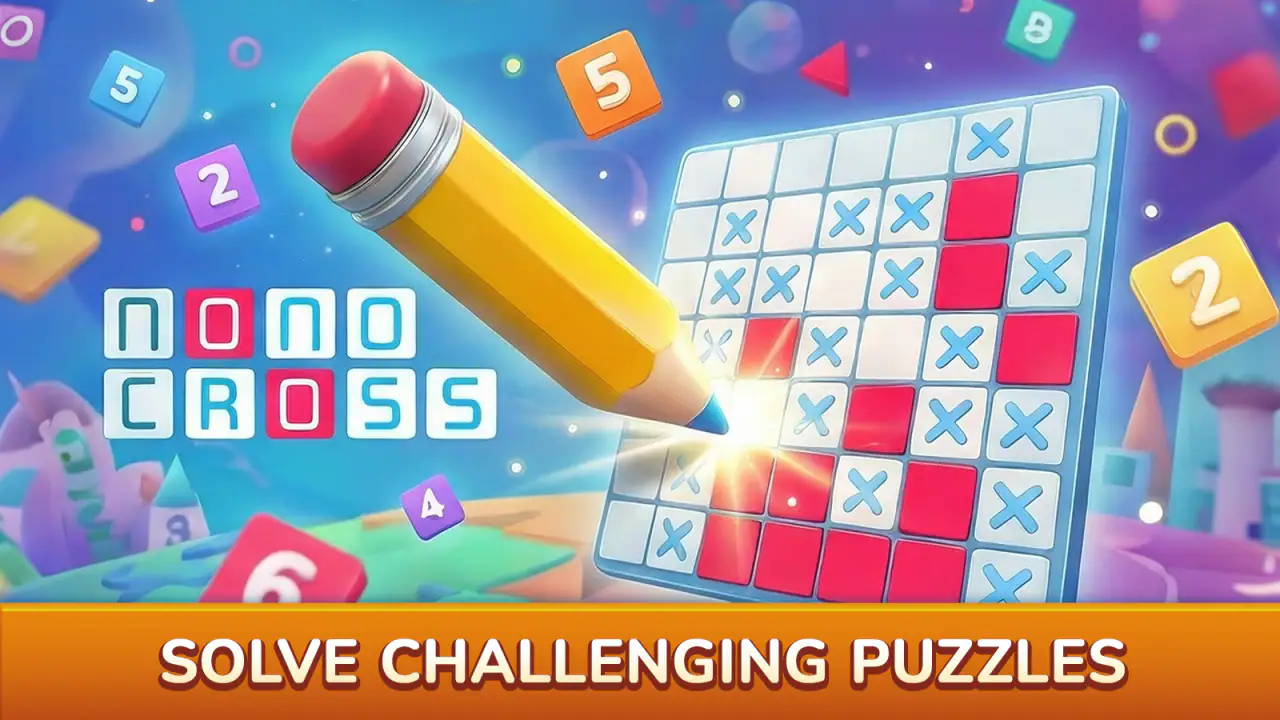
A useful habit is to work in passes. First inspect rows or columns with clues that occupy most of the available space. Then mark the cells that are definitely filled or definitely empty. After that, scan the crossing lines again. This approach is less frustrating than jumping randomly around the board, and it helps you see why each move is justified.
My best beginner tip is to treat empty spaces as information, not as unused space. In Nonogram puzzles, confirming that a cell cannot be filled can be just as valuable as filling one. An empty square can separate clue groups, narrow the position of a run, and unlock a line that previously looked impossible.
The first meaningful success
The first real breakthrough usually comes when you stop asking, “What might this picture be?” and start asking, “Which cells are unavoidable?” Suppose a row contains a group that is too long to move freely across its line. By comparing the group’s earliest and latest possible positions, you can identify the overlap. Those overlapping cells are safe deductions, even without knowing the final image.
Once you make that kind of move, check the affected columns immediately. A filled cell may complete a vertical clue, while an empty cell may create the separation required between two groups. This back-and-forth is where the puzzle becomes more interesting than a simple coloring exercise.
I also recommend pausing after every cluster of deductions. It is tempting to tap quickly when several cells seem obvious, but a short pause helps catch the difference between certainty and assumption. If the game provides a way to mark cells as empty, use that marking consistently. If you prefer solving with minimal markings, at least keep a mental note of which conclusions came from clues and which came from visual intuition.
A meaningful first success does not have to mean completing an entire puzzle immediately. It can be correctly resolving one difficult row, discovering a hidden separation, or recovering from an apparently stalled board by reviewing the clues. Those smaller moments teach the logic that makes later puzzles manageable.
Where new players commonly get confused
The most common mistake is reading a clue number as the total number of filled cells in a line without considering grouping. A clue of three means three consecutive filled cells. Two clues, such as two and one, mean a group of two and a separate group of one, with at least one empty cell between them. Forgetting that separation can make an otherwise correct puzzle appear contradictory.
Another source of confusion is assuming that a completed-looking row is enough to finish the puzzle. Every filled group must also agree with its crossing columns. A line can look visually convincing while still violating a vertical clue. I learned to use the picture as a progress signal, but never as proof that a move is correct.
Players can also get stuck by filling cells that are merely possible. Possibility is not certainty. If two placements could fit a clue, leave both open until another row or column removes one of them. This conservative style may feel slower, but it prevents a single guess from spreading errors through the board.
When progress stops, do not immediately restart. Recheck the longest clues first, then inspect lines where several cells have already been marked empty. Those lines often contain a forced placement that was easy to overlook. I find this review process more useful than staring at the emerging artwork, because the artwork can encourage guesses while the numbers provide dependable evidence.
How to make short sessions worthwhile
Nonocross works well in small pieces of time. I can imagine using it during a quiet break, while waiting for an appointment, or at the end of the day when I want something more focused than scrolling. A short session can still feel productive because one deduction may trigger several others, even if the whole picture remains unfinished.
For a realistic everyday routine, I would choose one puzzle and set a simple goal: resolve one difficult line, not necessarily complete the board. That keeps the session relaxed and avoids turning a calm puzzle into a race. If you return later, begin by reviewing the clues around your last confirmed move. Reconstructing the logic is usually easier than trying to remember the entire board from memory.
The game is also suitable for players who like screen-based activities without sound-heavy action. Its appeal comes from attention and pattern recognition rather than reflexes. On the other hand, anyone looking for a fast arcade-style distraction may find the deliberate pace too restrained.
What makes the pixel-art reveal worthwhile
The hidden image gives each puzzle a sense of direction. Instead of filling an abstract grid with no visible purpose, you watch a recognizable shape emerge from your deductions. I like that the visual reward arrives gradually: a few isolated cells become edges, clusters, and eventually a complete design.
Still, the artwork should be viewed as motivation rather than the main solving tool. On a partially completed board, a vague shape can suggest several possibilities, and those guesses are not reliable enough to replace the clues. The strongest experience comes from letting the logic reveal the image naturally.
This also creates a useful trade-off. Players who enjoy traditional Nonograms may care most about the purity of the deduction, while newcomers may be drawn in by the promise of pixel art. Nonocross sits comfortably between those interests, but someone seeking elaborate story content or a large collection of unrelated puzzle types may prefer a broader puzzle app.
How it compares with familiar puzzle alternatives
Compared with a crossword, Nonocross relies less on vocabulary and more on spatial reasoning. You do not need specialist knowledge or a strong memory for facts. Compared with Sudoku, it offers a more visual form of deduction, with the added satisfaction of seeing an image take shape. The two games share a careful, elimination-based rhythm, but Nonograms make the relationship between local choices and a final picture more visible.
It is also different from a standard coloring game. Coloring apps usually focus on selecting attractive colors or following a picture, while Nonocross asks you to earn every filled cell through clue interpretation. If you want creative freedom, this may feel restrictive. If you prefer rules that lead to a definite solution, that restriction is exactly the point.
Against fast match-three games, the contrast is even clearer. Nonocross does not depend on rapid tapping or constant visual stimulation. It rewards leaving the board alone for a few seconds and thinking through consequences. I would choose it when I want to exercise concentration, but not when I need an energetic game to fill a very short, restless moment.
Who should try it, and who should skip it
I think Nonocross is a good fit for beginners who want an approachable introduction to Nonogram puzzles, casual players who enjoy completing visual patterns, and experienced logic fans looking for a compact way to practice the format. The Everyone age rating also makes the concept accessible to a wide range of players, although younger users may still benefit from someone explaining how grouped clues work.
It is less suitable for people who dislike puzzles with no obvious move, or who become irritated by checking the same row and column several times. The game asks for accuracy and restraint. If you prefer games where every tap produces immediate progress, the slower deduction cycle may feel unrewarding.
I would also skip it if your main goal is a deep narrative, multiplayer competition, or a broad set of puzzle mechanics. Nonocross has a focused identity: solve the grid and uncover the pixel image. That focus is a strength when it matches your taste, but it is not a substitute for variety.
A balanced look at the limitations
The main friction comes from the nature of Nonograms themselves. A puzzle can reach a point where no move feels obvious, and the player must carefully revisit earlier assumptions. That is satisfying for a logic enthusiast, but it can feel like a dead end for someone expecting constant forward motion.
The visual reveal can also create pressure to guess. When the image seems nearly recognizable, it is easy to fill a square because it “looks right.” I consider that a weakness of the experience only in the sense that the reward can tempt impatient players into undermining the logic. The best results come from resisting that temptation.
The public store figures show an average rating of 3.2 from over 400 ratings, with more than 90 written reviews. I would read that as a reason to approach the game with realistic expectations rather than as a final verdict. Puzzle preferences vary widely, and the important question is whether you enjoy this particular clue-and-grid format.
Nonocross has passed 100 thousand installs, which suggests that it has found an audience beyond a tiny group of puzzle specialists. It remains free to try, so the practical risk is low: install it, complete an introductory grid, and decide based on how the deduction process feels in your hands.
The next step after your first puzzle
After completing the first board, resist the urge to solve every later puzzle in exactly the same order. Instead, develop a repeatable scan: look for lines with the largest clue groups, compare their possible placements, mark definite overlaps, and then use the crossings to refine the rest. This workflow becomes especially useful when a puzzle contains several plausible openings.
For a stronger challenge, try solving without relying on the emerging picture. Covering part of the board mentally, or focusing on clues rather than the artwork, forces you to trust the deduction process. Conversely, if you are teaching the game to someone else, explain one row and one column at a time. Showing how a filled cell changes a crossing clue is more helpful than simply telling them where to tap.
Keep your sessions flexible. If a board becomes tiring, stop after recording the last certain deduction and return later. Puzzle fatigue makes guesses feel more convincing than they are. A fresh look often reveals that the missing move was not difficult, only overlooked.
My final impression is that Nonocross is strongest as a calm, focused Nonogram game with a clear visual payoff. It does not try to be an all-purpose entertainment app, and that narrow aim works in its favor. The free price and Everyone rating make it easy to explore, while the Android 7.0 minimum keeps it accessible to many devices. Just remember that the real reward is not tapping quickly or predicting the picture; it is watching a correct chain of small decisions turn an empty grid into something recognizable.
FAQs for Nonocross
What is Nonocross, and how is the game played?
Nonocross is a logic puzzle game based on nonograms, also known as Picross or picture cross puzzles. You use the numbered clues beside each row and column to determine which squares should be filled and which should remain empty. When solved correctly, the grid reveals a hidden pixel-art image. The game is primarily about deduction rather than speed, making it suitable for short sessions or longer relaxing play.
Is Nonocross suitable for beginners?
Yes. Nonocross is generally accessible to beginners because the puzzles are built around clear numerical clues and gradually introduce more complicated grids. New players can learn the basic rules through the early levels, while larger and more demanding puzzles provide a challenge for experienced nonogram fans. It is helpful to understand that consecutive numbers represent groups of filled squares separated by at least one blank square.
Can I play Nonocross without an internet connection?
Nonocross is designed mainly as a puzzle game, so many of its core levels may be playable offline once they are available on your device. However, features such as advertisements, cloud synchronization, online events, updates, or in-app purchases can require an internet connection. Before relying on offline play, it is worth opening a few puzzles in airplane mode and checking whether the specific version supports all desired content without connectivity.
Does Nonocross contain advertisements or in-app purchases?
Depending on the version and platform, Nonocross may include advertising and optional in-app purchases. Ads can commonly appear between puzzles or when using extra assistance, while purchases may offer ad removal, hints, bonus content, or other convenience features. The basic puzzle experience can usually be enjoyed without spending money, but users should review the store listing and purchase details before downloading, especially on shared or family devices.
What happens if I make a mistake while solving a Nonocross puzzle?
Mistakes in Nonocross are usually manageable rather than permanent. The game may mark an incorrect square, reduce a life, add a penalty, or simply allow you to undo the move, depending on the selected mode and the app version. Most puzzles provide some form of assistance, such as hints or error checking, although these tools may be limited. Careful deduction is still recommended because excessive help can reduce the challenge.
Pros
- Relaxing nonogram puzzles suitable for short or extended play sessions.
- Clear visual grid makes clues easy to follow on smaller phone screens.
- Large variety of puzzles helps keep gameplay fresh over time.
- Offline play is convenient when traveling or using limited mobile data.
- Simple controls make it accessible for beginners and casual players.
Cons
- Some puzzles may feel repetitive after extended play sessions.
- Higher difficulty levels can be frustrating without an undo or hint strategy.
- Progress may not transfer smoothly between devices without account support.
- Small cells can be challenging to tap accurately on compact screens.
- Optional hints or extra features may be limited by ads or in-app purchases.


